
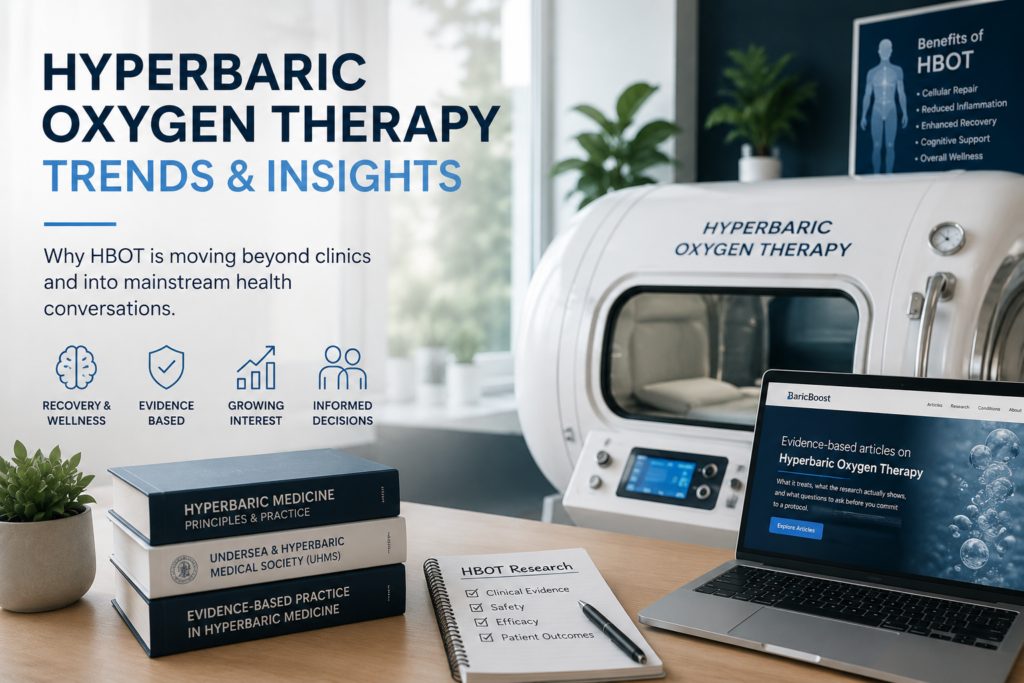
The Wellness Industry Started Asking Different Questions
Over the last few years, hyperbaric oxygen therapy has quietly moved beyond its traditional clinical environment and entered broader public discussion around recovery, wellness, longevity, and performance. What was once viewed as a highly specialised treatment associated mainly with wound care and decompression sickness is now being explored by athletes, health-conscious consumers, wellness clinics, and patients researching alternative recovery approaches.
This shift is not happening because of marketing alone. Public interest has grown alongside wider conversations around preventative health, inflammation management, recovery science, cognitive performance, and evidence-based wellness technologies.
At the same time, the rapid increase in online discussion has created a second challenge: separating credible information from exaggerated claims.
That is one reason why patient-first educational resources and evidence-focused platforms are becoming increasingly important within modern healthcare conversations.
Public Curiosity Around HBOT Has Expanded Rapidly
Part of the reason hyperbaric oxygen therapy trends continue accelerating is because modern consumers research health differently than they did a decade ago.
Patients no longer rely only on short consultations or advertisements. They compare studies, watch interviews, read treatment experiences, and search for long-form educational material before making decisions. In areas connected to wellness and recovery, this behaviour has become even more visible.
Hyperbaric oxygen therapy now appears in discussions surrounding:
- Recovery and rehabilitation
- Athletic performance
- Neurological research
- Inflammation management
- Longevity and wellness optimisation
- Cognitive recovery
- Post-surgical recovery support
This growing visibility has naturally increased the number of clinics, wellness centres, and online publishers discussing HBOT.
However, increased attention also brings increased noise.
The Information Gap Around Hyperbaric Oxygen Therapy
One of the largest issues within emerging healthcare trends is that public understanding often grows faster than scientific literacy.
In the case of HBOT, consumers frequently encounter:
- Aggressive affiliate marketing
- Overstated treatment claims
- Poorly sourced medical content
- Confusion between approved and off-label use
- Commercially biased recommendations
For patients trying to make informed decisions, this creates uncertainty.
That is why independent educational platforms are beginning to play a larger role within the HBOT ecosystem. Instead of functioning as clinics or supplement sellers, these platforms focus on explaining how hyperbaric oxygen therapy works, what evidence currently supports, and where limitations still exist.
Resources such as BaricBoost are part of this broader shift toward patient-first education. Rather than promoting treatments directly, the platform publishes evidence-based information around hyperbaric oxygen therapy, treatment research, protocol discussions, and the importance of understanding FDA-cleared versus off-label applications.
This type of educational structure is becoming increasingly valuable as wellness conversations move into the mainstream.
Mainstream Health Conversations Are Becoming More Evidence-Oriented
Another reason hyperbaric oxygen therapy trends are growing is because consumers have become more sceptical of exaggerated wellness marketing overall.
Modern health audiences increasingly ask questions such as:
- What does the research actually show?
- Is this FDA-cleared or experimental?
- Are claims being supported properly?
- What risks or limitations exist?
- Is the source financially incentivised?
This behavioural shift is changing how authority is built within health and wellness industries.
In the past, visibility alone often shaped perception. Today, credibility, sourcing standards, and transparency carry far more weight, especially when treatments involve long-term health decisions.
Platforms referencing recognised standards such as UHMS guidelines, peer-reviewed literature, and ICMJE publishing principles naturally gain stronger trust over time because they align more closely with how educated consumers now evaluate information.
Wellness Markets Are Becoming More Sophisticated
The broader wellness industry itself has also matured significantly.
Consumers are no longer searching only for quick solutions. Many are now building long-term health routines around sleep optimisation, recovery systems, metabolic health, stress management, and preventative care.
As this shift continues, treatments like hyperbaric oxygen therapy are increasingly entering wider wellness ecosystems rather than remaining isolated inside specialist clinical discussions.
This does not mean every claim surrounding HBOT is automatically validated. Far from it.
It simply means public interest is growing faster, and with that growth comes a stronger need for trustworthy educational infrastructure.
That infrastructure includes:
- Evidence-focused publications
- Independent educational platforms
- Long-form medical explainers
- Research interpretation
- Patient literacy resources
- Transparent discussion around limitations and risks
The healthcare businesses and publishers that prioritise clarity over hype are likely to build the strongest long-term trust as the industry evolves.
Why Authority Matters More Than Visibility in Modern Healthcare
One of the more interesting shifts happening across healthcare publishing is that authority itself is becoming measurable through transparency.
Brands and publishers that openly distinguish between:
- approved use
- emerging research
- theory
- anecdotal outcomes
- commercial interests
tend to build stronger credibility over time.
The same principle applies across digital authority itself. Organisations that build structured educational ecosystems often outperform brands relying purely on short-term visibility tactics, which aligns closely with the long-term thinking behind Connectively’s Authority Engineering Framework™.
In healthcare especially, visibility without trust eventually collapses.
That is why editorial authority, contextual education, and evidence-focused positioning are becoming increasingly connected.
Looking Ahead
Hyperbaric oxygen therapy is unlikely to remain a niche medical conversation over the next decade.
Public awareness is increasing. Wellness markets are expanding. Patients are becoming more research-oriented. Recovery technologies are attracting wider interest. At the same time, scrutiny around medical claims is also intensifying.
This combination creates a unique environment where independent educational platforms may become just as important as clinics themselves.
As healthcare conversations continue evolving, the organisations that communicate with clarity, transparency, and evidence are likely to shape how the next generation of wellness consumers learns, researches, and makes decisions.
Visibility Means Little Without Trust Behind It
Connectively helps founders and growing brands build long-term authority through editorial backlinks, PR placements, and strategic positioning that strengthens both visibility and credibility.
Connectively.uk
Connectively builds digital authority for brands through real backlinks, trusted media placements, and strategic visibility — with transparency and results.
Links
Contact
info@connectively.uk
United Kingdom
Connectively is a UK-based digital authority agency serving brands worldwide.
© 2026 Connectively.uk — All rights reserved