
Why Choosing the Right Editorial Backlink Provider Matters
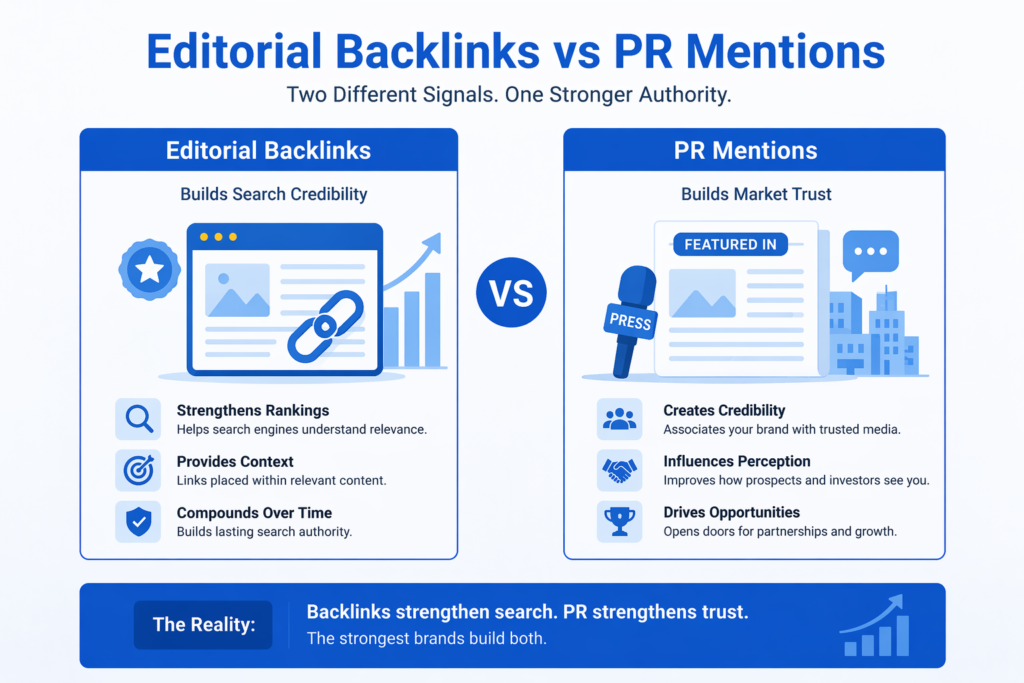
For many companies, editorial backlinks and PR mentions are discussed as if they solve the same problem. They do not. Both can strengthen a brand, both can improve visibility, and both can contribute to long term growth, but they play different roles inside a serious authority strategy. That distinction matters because brands often invest in one while expecting outcomes that belong to the other. Some buy backlinks and expect instant trust. Others chase mentions and assume visibility alone will strengthen search performance. In reality, authority is built when credible signals work together, not when one tactic is forced to carry the entire system.
At Connectively, we look at authority as a structured progression rather than a collection of disconnected wins. The broader logic is already explained in the Authority Engineering Framework, where visibility, credibility, positioning, and trust are treated as stages rather than isolated tactics. Editorial backlinks and PR mentions belong inside that progression. They should not be treated as interchangeable assets, and they should not be judged by the same standards. One often strengthens discoverability and contextual SEO relevance. The other often strengthens perception, legitimacy, and market recognition. Strong brands understand both.
What Editorial Backlinks Actually Do
When placed naturally within relevant content on trusted websites, editorial backlinks hold the most value. They are not just links for the sake of links. Their role is to strengthen the relationship between your brand and the topics you want to be known for. When a contextual link appears within a relevant article, it can reinforce topical alignment, support discoverability, and contribute to search engine understanding of where your brand fits. That is why a serious editorial backlink is judged by context, publisher quality, audience relevance, and placement integrity rather than by simple metrics alone.
The problem is that the market has diluted the term. Many providers call almost any paid link an editorial backlink, even when the surrounding content is weak, the site itself has little real audience value, or the placement was created through a repeatable network model. That is exactly why companies are advised to evaluate placements carefully rather than buying blindly. If someone wants to understand that side more deeply, our guide on how to evaluate an editorial backlink provider breaks down what serious buyers should actually check.
What PR Metions Actually Do
PR mentions work differently. In many cases, the immediate value is not the link itself. The value is association. A credible mention places your brand inside a trusted media, industry, or narrative environment. It tells prospects, investors, searchers, and market observers that your brand is being seen in the right places. Even when the SEO effect is less direct than a strong contextual backlink, the credibility effect can be significant. A mention can support brand trust, improve conversion confidence, strengthen founder positioning, and create a perception of momentum that ordinary content cannot generate by itself.
This is why PR should not be judged only by whether a mention is followed or whether it passes direct ranking value. That is too narrow. A strong mention can influence how people perceive your seriousness before they ever visit your website. It can also support the broader narrative around your company, especially when your market is crowded and your audience needs external validation before making decisions. This is one reason our PR Mentions approach is framed around strategic visibility rather than vanity placements.
Why Brands Get Confused
Confusion happens when brands expect one signal to produce the outcome of another. A company may invest in backlinks because it wants rankings, but what it actually lacks is trust. Another company may secure a few media mentions, but what it really needs is stronger topical relevance and search visibility around its offer. In both cases, the tactic is not wrong. The mismatch is in the expectation. When the strategy is unclear, even good placements can feel disappointing because they were asked to solve the wrong problem.
This is especially common in B2B and SaaS markets where founders are under pressure to look credible quickly. The temptation is to choose whichever asset sounds more impressive on the surface. Editorial backlinks sound useful because they appear measurable. PR mentions sound powerful because they appear prestigious. But authority is not built by surface appeal. It is built when the right signal is matched to the right strategic gap. That is why serious companies should not ask, “Which is better?” They should ask, “What do we lack right now: search relevance, market trust, or both?”
Editorial Backlinks Improve Search Credibility
Where editorial backlinks are done properly, they help strengthen search credibility through contextual reinforcement. A link inside relevant content can connect your brand to a commercial or strategic topic in a way that directory links, profile links, and other low trust placements simply cannot. This becomes more valuable when the article itself is useful, the publisher is legitimate, and the link exists as a natural extension of the content rather than an obvious insertion. When companies buy editorial backlinks safely, the goal is not to manipulate rankings temporarily. The goal is to place the brand inside trustworthy editorial environments that search engines and readers both recognise as legitimate. That distinction is covered in our article on how companies safely buy editorial backlinks without risking their SEO.
A strong editorial backlink can also support long-term search performance because it contributes to a cleaner authority profile. It tells a more coherent story about your brand than random placements ever could. Over time, a portfolio of relevant, trusted, contextual links can compound into stronger visibility and stronger perceived legitimacy. But again, this works best when the placements are part of a wider brand strategy rather than treated as isolated purchases.
PR Mentions Improve Market Confidence
PR mentions are often more powerful when the real objective is market confidence. They can create the kind of trust that reduces hesitation during buying decisions. Prospects do not always analyse links, but they do notice names, platforms, and patterns. When they see that a company has been featured, referenced, quoted, or included in credible editorial spaces, the brand starts to feel safer. That feeling matters. Authority is not only about what search engines understand. It is also about what decision makers believe.
This is why PR mentions often carry value beyond SEO reporting. They can help a founder look more established, a company look more credible, and a service look more proven. In competitive markets, that perception can influence response rates, conversion rates, partnership interest, and investor confidence. PR alone is not enough to build a full authority system, but when combined with other trust signals it can become one of the strongest accelerators of brand legitimacy.
Why Serious Brands Need Both Editorial Backlinks and PR Mentions
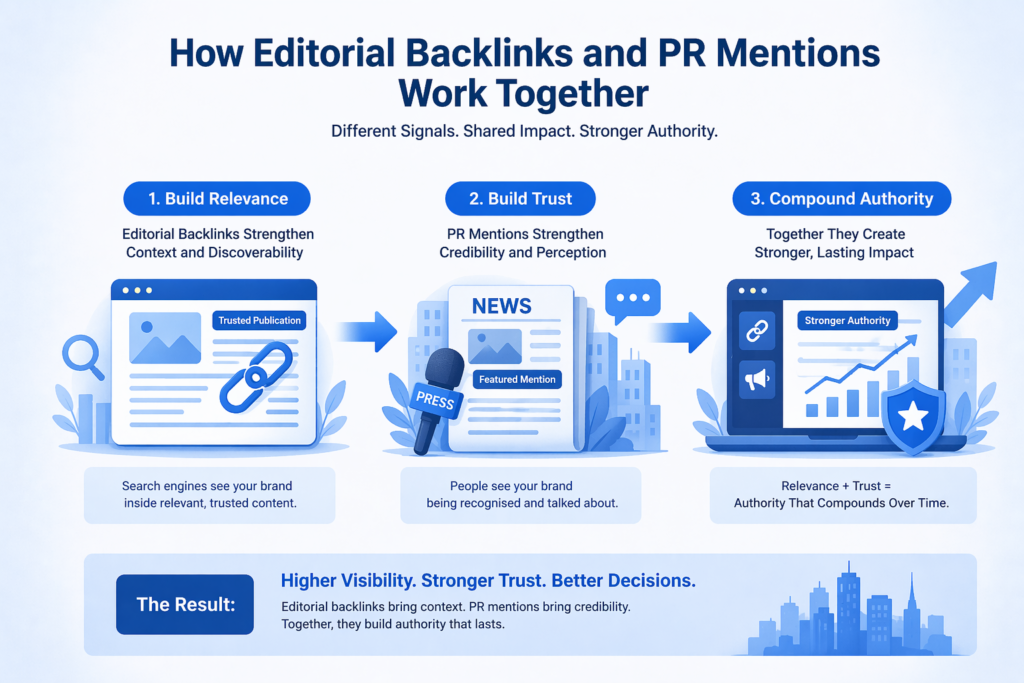
The strongest authority systems are built when editorial backlinks and PR mentions are aligned instead of separated. Editorial backlinks strengthen contextual search trust. PR mentions strengthen perceived credibility and market recognition. Together, they create a more believable authority profile. One helps reinforce discoverability and relevance. The other helps reinforce legitimacy and confidence. When both are present, your brand feels more established because it is being supported from multiple angles rather than relying on a single mechanism.
This is also why authority compounds more effectively when the strategy is intentional. A brand that earns relevant editorial links, appears in credible conversations, publishes thoughtful content, and reinforces its positioning consistently will usually outperform a brand that focuses on volume alone. The outcome is not just more traffic. It is stronger confidence across the entire journey, from first impression to final decision. That is the difference between visibility and authority.
When to Prioritise Editorial Backlinks
There are moments when editorial backlinks should come first. If a company has a strong product and a decent site but weak contextual authority around its service pages, trusted backlinks can help reinforce the commercial and topical relevance that search engines rely on. If rankings are stagnant and the existing link profile is weak or low quality, a strategic editorial backlink campaign may be the cleaner move. It is especially useful when the company wants to strengthen pages with direct commercial intent, such as solution pages, service pages, or category pages. For brands in that position, our Backlinks page explains how we think about contextual authority rather than volume based link building.
When to Prioritise PR Mentions
There are also moments when PR mentions should come first. If the company is entering a crowded market, raising visibility with investors, trying to improve founder credibility, or preparing for stronger sales conversations, PR can do more than additional links alone. When trust is the gap, mentions often create faster perception change than search-focused assets. The same is true when a company has already built a decent SEO base but still feels unknown or unproven in the eyes of buyers. In those cases, media visibility becomes a credibility layer rather than a traffic play.
Final Thoughts
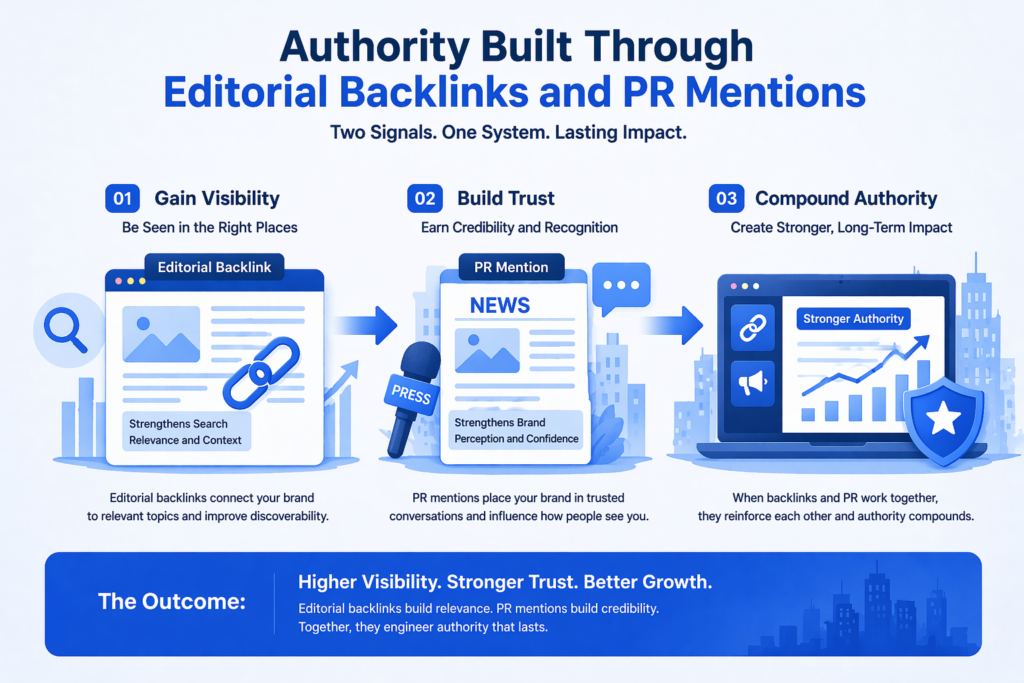
Editorial backlinks and PR mentions are not competing tactics. They are different authority signals serving different purposes. One is not automatically better than the other. The real question is what your brand needs most right now and whether your current strategy reflects that honestly. Companies that understand this build stronger authority because they stop chasing single channel fixes and start building a system of trust. That system is what turns visibility into confidence, and confidence into long term growth.
If a brand wants durable authority, it should think beyond isolated placements. It should ask how search trust, market trust, editorial context, and brand perception work together. That is where authority stops being accidental and starts becoming intentional.
Looking To Build Authority With The Right Signals?
If your brand needs stronger editorial visibility, strategic PR support, or both, explore the services built to strengthen authority properly.
Connectively.uk
Connectively builds digital authority for brands through real backlinks, trusted media placements, and strategic visibility — with transparency and results.
Links
Contact
info@connectively.uk
United Kingdom
Connectively is a UK-based digital authority agency serving brands worldwide.
© 2026 Connectively.uk — All rights reserved